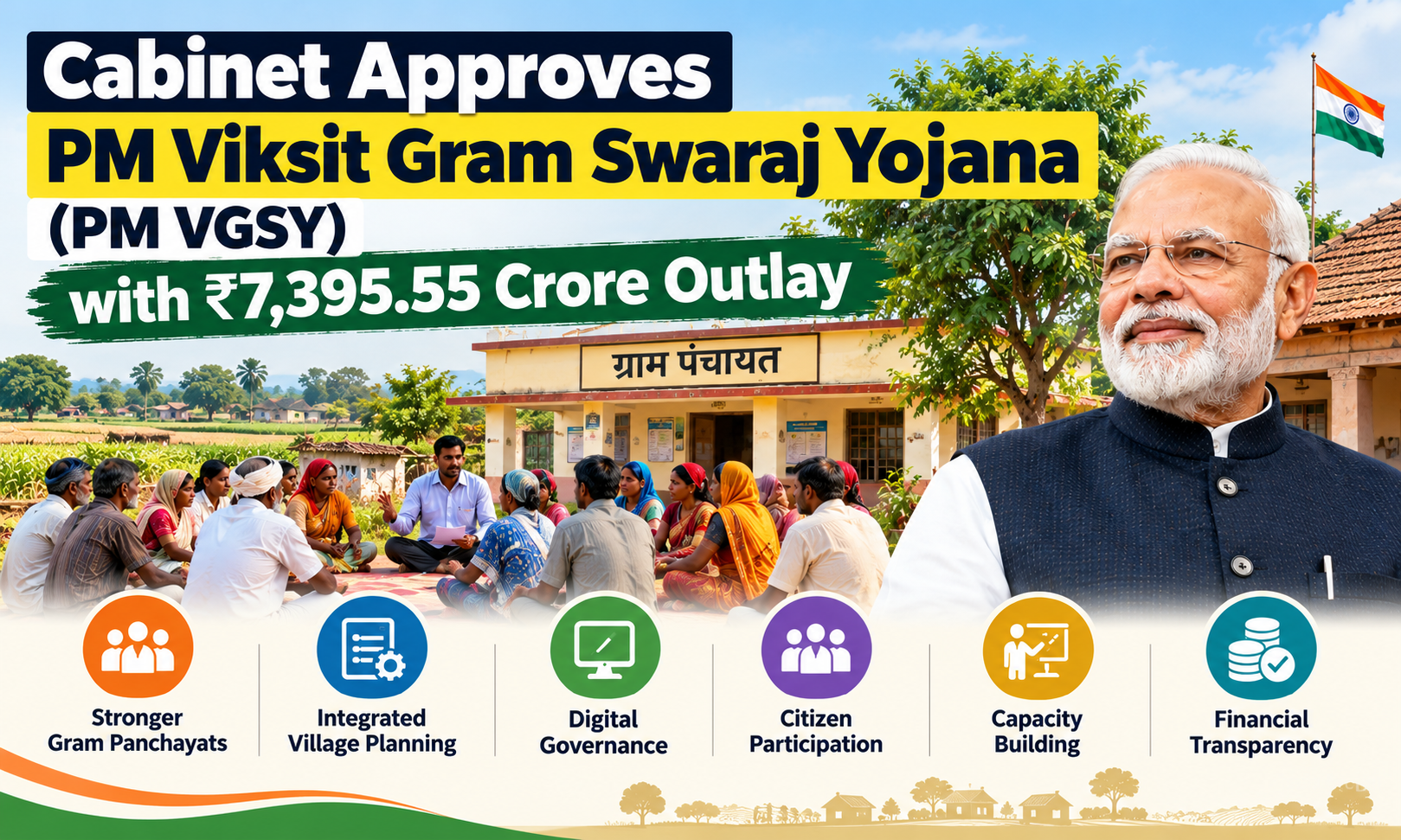
Cabinet Approves PM Viksit Gram Swaraj Yojana (PM VGSY) with ₹7,395.55 Crore Outlay
Key points
Why in the News?
The Union Cabinet has approved the Pradhan Mantri Viksit Gram Swaraj Yojana (PM VGSY), a Centrally Sponsored Scheme aimed at strengthening Gram Panchayats and improving rural local governance. The scheme will be implemented from 2026–27 to 2030–31 with a total financial outlay of ₹7,395.55 crore.
Key Highlights
Particular | Details |
|---|---|
Scheme | Pradhan Mantri Viksit Gram Swaraj Yojana |
Abbreviation | PM VGSY |
Approved by | Union Cabinet |
Nodal Ministry | Ministry of Panchayati Raj |
Scheme Type | Centrally Sponsored Scheme |
Total Outlay | ₹7,395.55 crore |
Central Share | ₹4,869.48 crore |
State Share | ₹2,526.07 crore |
Implementation Period | 2026–27 to 2030–31 |
Coverage | All States and Union Territories |
Institutional Coverage | More than 2.55 lakh Panchayats and traditional local bodies |
Expected Direct Beneficiaries | Around 32 lakh elected representatives, Panchayat functionaries and other stakeholders |
What Is the Objective of PM VGSY?
The main objective is to transform Gram Panchayats into empowered, accountable and self-reliant institutions of local self-government. The scheme aims to connect village-level development priorities with government programmes, available funds and local community needs.
It also seeks to improve coordination between Central Ministries, State Governments and local bodies so that development activities can be planned and monitored more effectively.
Six Important Focus Areas
1. Strengthening Gram Panchayats: Panchayats will be supported in coordinating local development priorities and government interventions.
2. Integrated Village Planning: The scheme aims to support the preparation of more than 2.55 lakh Gram Panchayat Development Plans (GPDPs) annually through the eGramSwaraj portal.
3. Digital Governance: Information about government schemes, beneficiaries, benefits, community assets and available resources will be integrated to support better planning and monitoring.
4. Public Participation: Gram Sabhas, Panchayat forums and digital outreach platforms will help citizens understand government initiatives and participate in local development discussions. Each coordinated awareness-generation exercise aims to reach at least one crore citizens.
5. Capacity Building: Around 32 lakh elected representatives, Panchayat functionaries and other stakeholders are expected to receive capacity-building support and digital assistance.
6. Financial Accountability: The scheme aims to support at least 2.55 lakh online audit plans annually, alongside improved accounting, public disclosure and mobilisation of Own Source Revenue (OSR).
Important Digital Platforms
eGramSwaraj: A digital platform supporting Panchayat planning and governance processes. Under the scheme, it will support the preparation of integrated Gram Panchayat Development Plans.
AuditOnline: A platform used for online auditing of Panchayati Raj accounts. It supports transparency and accountability in local financial management.
PANCHAM: An AI-enabled, multilingual, two-way communication platform available in 17 Indian languages. It supports communication about government schemes, training material and Panchayat-related information.
Background: What Is a Gram Panchayat?
A Gram Panchayat is a rural local self-government institution. Panchayats are part of India's decentralised governance system and help identify local needs, prepare development plans and support the implementation of public programmes.
The 73rd Constitutional Amendment Act, 1992 gave constitutional status to Panchayati Raj Institutions. Part IX of the Constitution deals with Panchayats, while the Eleventh Schedule lists 29 subjects that may be devolved to Panchayats by State Legislatures.
The Gram Sabha consists of persons registered in the electoral rolls relating to a village within the area of a Gram Panchayat. It provides a forum for local participation and discussion of village-level issues.
Why Is This Scheme Important?
It strengthens decentralised planning and grassroots governance.
It aims to improve coordination between government departments and village-level institutions.
Digital integration can help Panchayats identify development gaps and monitor public programmes.
Online audits and public disclosure can improve financial transparency.
Capacity building can help elected representatives and Panchayat functionaries manage local development more effectively.
The scheme covers all States and Union Territories, including eligible traditional rural local government institutions in areas where Panchayats do not exist under Part IX of the Constitution.
Important Facts to Remember
Total outlay: ₹7,395.55 crore.
Central share: ₹4,869.48 crore.
State share: ₹2,526.07 crore.
Implementation period: 2026–27 to 2030–31.
Ministry: Ministry of Panchayati Raj.
Annual planning target: More than 2.55 lakh Gram Panchayat Development Plans.
Annual audit target: At least 2.55 lakh online audit plans.
PANCHAM: AI-enabled communication platform available in 17 Indian languages.
Constitutional background: 73rd Constitutional Amendment Act, 1992; Part IX and the Eleventh Schedule of the Constitution.
Conclusion
Pradhan Mantri Viksit Gram Swaraj Yojana aims to strengthen rural local governance through integrated planning, digital systems, capacity building, citizen participation and financial accountability. It seeks to help Panchayats connect national development priorities with local needs as part of the broader vision of Viksit Bharat.