RRB NTPC Mock Test 2026: How to Practise, Analyse and Improve
Practice with mock tests built specifically for Railway Recruitment Board Non-Technical Popular Categories.
RRB NTPC Graduate Mock Tests 2026-27 – Full-Length Series with Solutions

⭐ 5.00Free
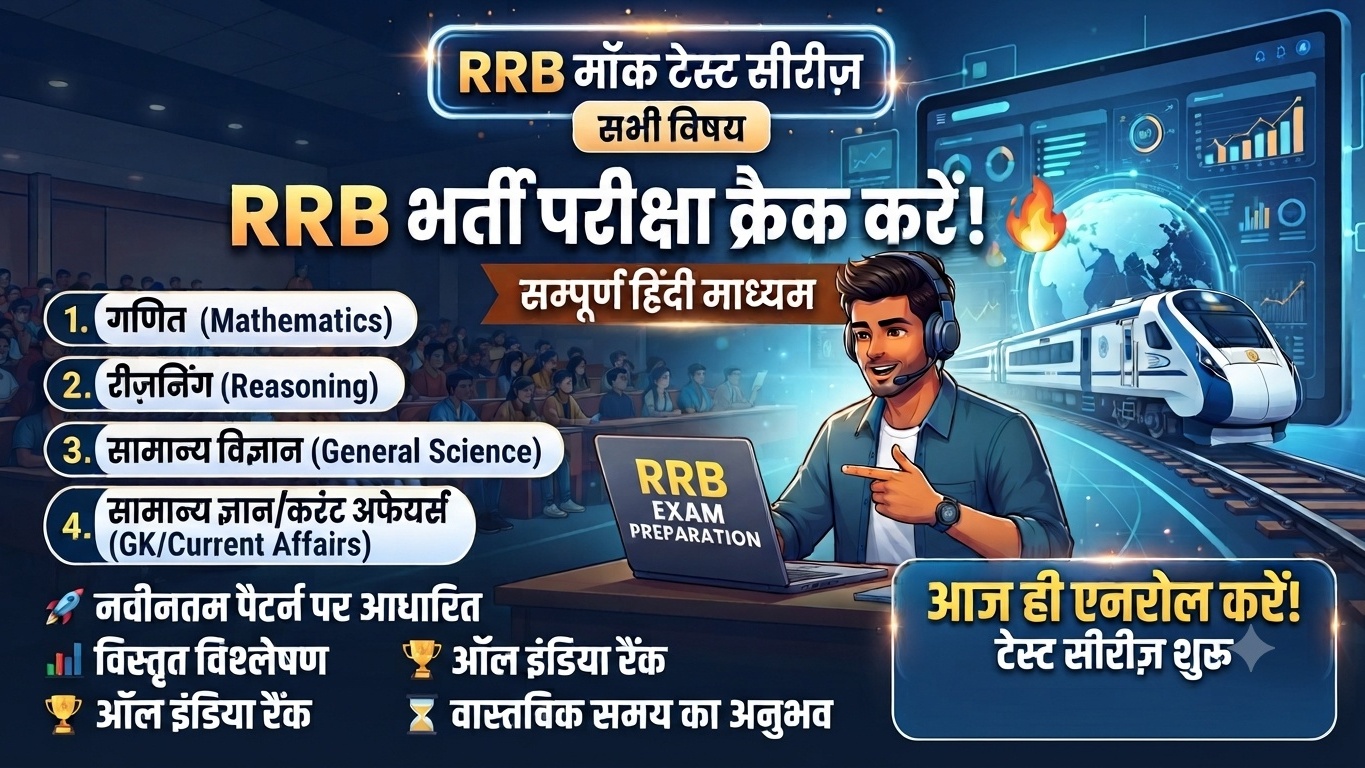
RRB Mock Test All Subjects in Hindi most VVI
₹1,000₹99
Unlimited Gyan - 200 General Knowledge Questions
Free
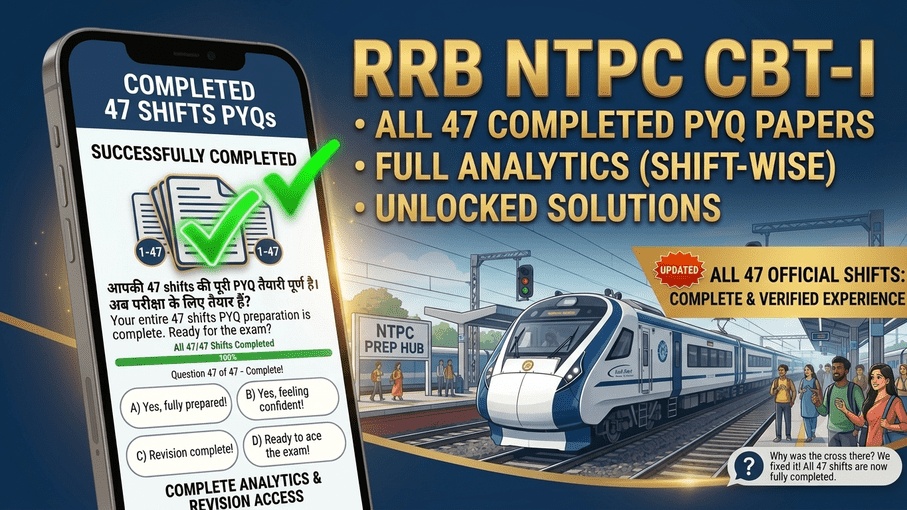
RRB NTPC 2025 CBT 1
₹100
Logical Reasoning Practice Test 40 Questions
Free
RRB NTPC 2026 Most Expected 50 MCQs | June Special
₹39₹21
RRB NTPC 2026 Test
₹100
Railway Advance Math: Number System Mastery Test
Free
SSC GD 2027 Test
₹100
Government Exams GK & GS Mock Test 250 MCQ Hindi

₹399₹49
RRB Ntpc
Free
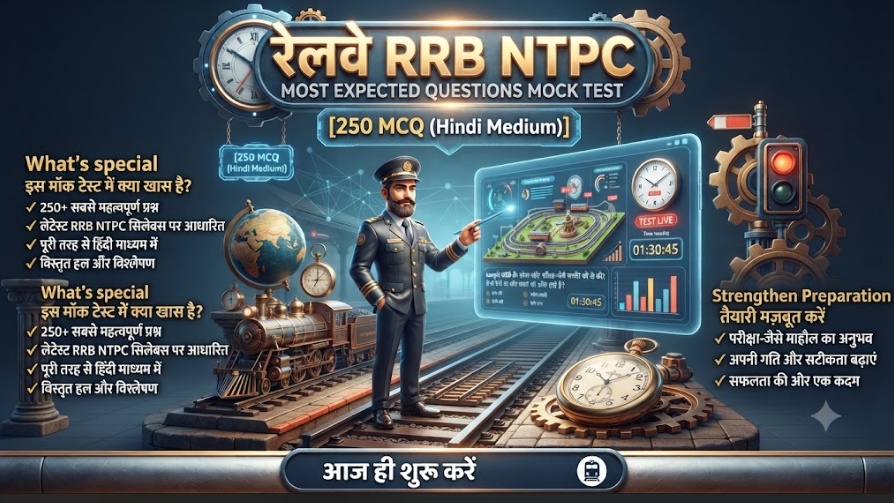
RRB NTPC Mock Test 250 Most Expected Questions Hindi
₹499₹49
An RRB NTPC mock test is a full-length or sectional practice test designed on the actual CBT pattern. It helps you check your speed, accuracy and exam temperament before the real exam. Used well, mock tests show you exactly where you lose marks. Used badly, they only produce scores that tell you very little.
With 5,165 vacancies announced for RRB NTPC 2026 and applications opening in October, the months before the CBT are the right time to build a mock test routine. This guide covers the types of mock tests, how to choose a good one, how many to take, how to analyse them and the mistakes to avoid, for both Graduate and Undergraduate aspirants.
Why Mock Tests Matter So Much in RRB NTPC
The RRB NTPC exam is less about knowing everything and more about answering correctly within strict time limits. Three features of the exam make mock tests essential:
Tight timing: CBT 1 gives you about 54 seconds per question, and CBT 2 only about 45 seconds.
Negative marking: One-third of a mark is deducted for every wrong answer, so careless attempts reduce your score.
High cut-offs: In the previous Graduate cycle, reported UR cut-offs for CBT 1 crossed 80 marks in several zones. Small gains in accuracy can decide whether you are shortlisted.
Studying topics builds knowledge. Mock tests turn that knowledge into marks under exam conditions.
Types of RRB NTPC Mock Tests
Test Type | What It Covers | Best Used For |
|---|---|---|
Topic-wise test | One chapter, such as Percentage or Syllogism | Checking a topic right after studying it |
Sectional test | One full subject, such as Mathematics | Improving speed and accuracy in a single section |
Full-length CBT 1 mock | 100 questions in 90 minutes | Practising the screening stage |
Full-length CBT 2 mock | 120 questions in 90 minutes | Practising the merit-deciding stage |
Previous year paper | Actual questions from earlier NTPC exams | Understanding real difficulty and question style |
Current affairs test | Recent events, schemes and appointments | Regular GA revision |
A good preparation plan uses all of these at different stages, rather than relying only on full-length mocks.
How to Choose a Good RRB NTPC Mock Test
Not every test labelled "NTPC mock" follows the real exam. Before you rely on a mock test series, check the following:
Checkpoint | What to Look For |
|---|---|
Question count | 100 questions for CBT 1 and 120 for CBT 2 |
Section split | GA 40, Maths 30, Reasoning 30 (CBT 1); GA 50, Maths 35, Reasoning 35 (CBT 2) |
Timer | 90 minutes for the full test |
Negative marking | One-third mark deducted for each wrong answer |
Difficulty | Graduate-level or Class 12-level, matching the CEN you are applying for |
Solutions | Clear explanations, not just the correct option |
Analysis | Section-wise accuracy, time spent per question and topic-wise weak areas |
Language | Available in the language you will choose for the exam |
A mock test with 80 questions or no negative marking can still be useful for topic practice. However, it will not prepare you for the time pressure of the real CBT.
How Many Mock Tests Should You Take?
There is no magic number. The right number depends on how much of the syllabus you have covered and how well you analyse each test. The table below offers a practical guide.
Preparation Phase | Recommended Practice |
|---|---|
Foundation (syllabus coverage below 50%) | Topic-wise tests after every chapter; 1 full-length mock every 2 weeks to track progress |
Practice (syllabus coverage 50% to 90%) | 3 to 4 sectional tests a week; 1 full-length mock a week |
Final phase (last 6 to 8 weeks before CBT) | 2 to 3 full-length mocks a week, plus previous year papers |
Last week | 1 or 2 mocks for rhythm; focus on revision, not new material |
Taking more mocks without analysing them rarely improves scores. One well-analysed mock is worth more than three rushed ones.
How to Analyse an RRB NTPC Mock Test
Spend at least as much time reviewing a mock as you spent taking it. Follow these steps after every full-length test.
Step 1: Check Section-wise Accuracy
Divide your correct answers by your total attempts in each section. If your accuracy in a section is below about 80%, you are losing too many marks to negative marking in that section.
Step 2: Sort Every Mistake by Its Cause
Use a simple error log. It helps you see patterns you would otherwise miss.
Question | Section | Topic | Reason for Error | Fix |
|---|---|---|---|---|
Q14 | Maths | Time and Work | Concept not clear | Revise the chapter and solve 20 questions |
Q37 | Reasoning | Syllogism | Misread "some" as "all" | Read the statements twice |
Q62 | GA | Polity | Did not know the fact | Add to revision notes |
Q88 | Maths | Percentage | Calculation slip | Practise calculation speed daily |
Step 3: Review Time Spent
Find the questions where you spent more than two minutes. Ask whether you should have skipped them earlier. Learning when to leave a question is one of the most valuable skills in NTPC.
Step 4: Re-attempt Wrong and Skipped Questions
Solve them again without a timer a day later. If you still get them wrong, the issue is conceptual and needs revision, not more tests.
Step 5: Compare With Your Target
Compare your score with the previous cut-off for your RRB, category and post group. This keeps your target realistic.
CBT 1 Mocks vs CBT 2 Mocks
Many aspirants keep taking CBT 1-level mocks even after they are scoring well in them. Since CBT 1 marks are not counted in the final merit, move to CBT 2-level practice once your CBT 1 mock scores are consistently strong.
Point | CBT 1 Mocks | CBT 2 Mocks |
|---|---|---|
Questions | 100 | 120 |
Time per question | About 54 seconds | About 45 seconds |
Main goal | Clear the shortlisting cut-off comfortably | Maximise your merit score |
When to focus | Early and middle stages of preparation | After CBT 1 scores are stable, and after the CBT 1 exam |
If you are applying to both the Graduate and Undergraduate CENs, practise at the Graduate standard. The Undergraduate paper will then feel easier.
Common Mock Test Mistakes to Avoid
Taking mocks too late: Start with sectional and topic tests early, not only in the final month.
Ignoring analysis: Checking only the score teaches you nothing about why you lost marks.
Attempting every question: Blind guessing on four options does not help on average with one-third negative marking.
Pausing or breaking the timer: Always complete a mock in one sitting, as you would in the exam hall.
Judging yourself by one mock: Look at the trend across five or six tests, not a single score.
Leaving GA for the end: General Awareness carries the most questions, and it improves steadily with regular revision.
The real CBT is taken on a computer with a question palette, a "mark for review" option and a countdown timer. Take online mocks on a laptop or desktop at least some of the time, so the interface feels familiar on exam day. In some previous cycles, RRBs also published a practice mock link on their websites before the CBT. If one is released for 2026, use it to learn the official interface.