
SSC GD Mock Test 2027: How to Practise and Improve Your Score
Full-length and topic-wise SSC GD practice tests with a clear plan to improve your score
Ancient History Mock Test [250 MCQ (Hindi Medium)] for SSC GD, SSC CGL, SSC MTS, SSC GD, RRB, Police, UPPSC, Banking, CTET/TETNDA/CDS and other competitive exam
₹9
SSC Reasoning: 1000 अति महत्वपूर्ण प्रश्न 🔥 | SSC GD, CHSL
₹50₹20
Unlimited Gyan - 200 General Knowledge Questions
Free
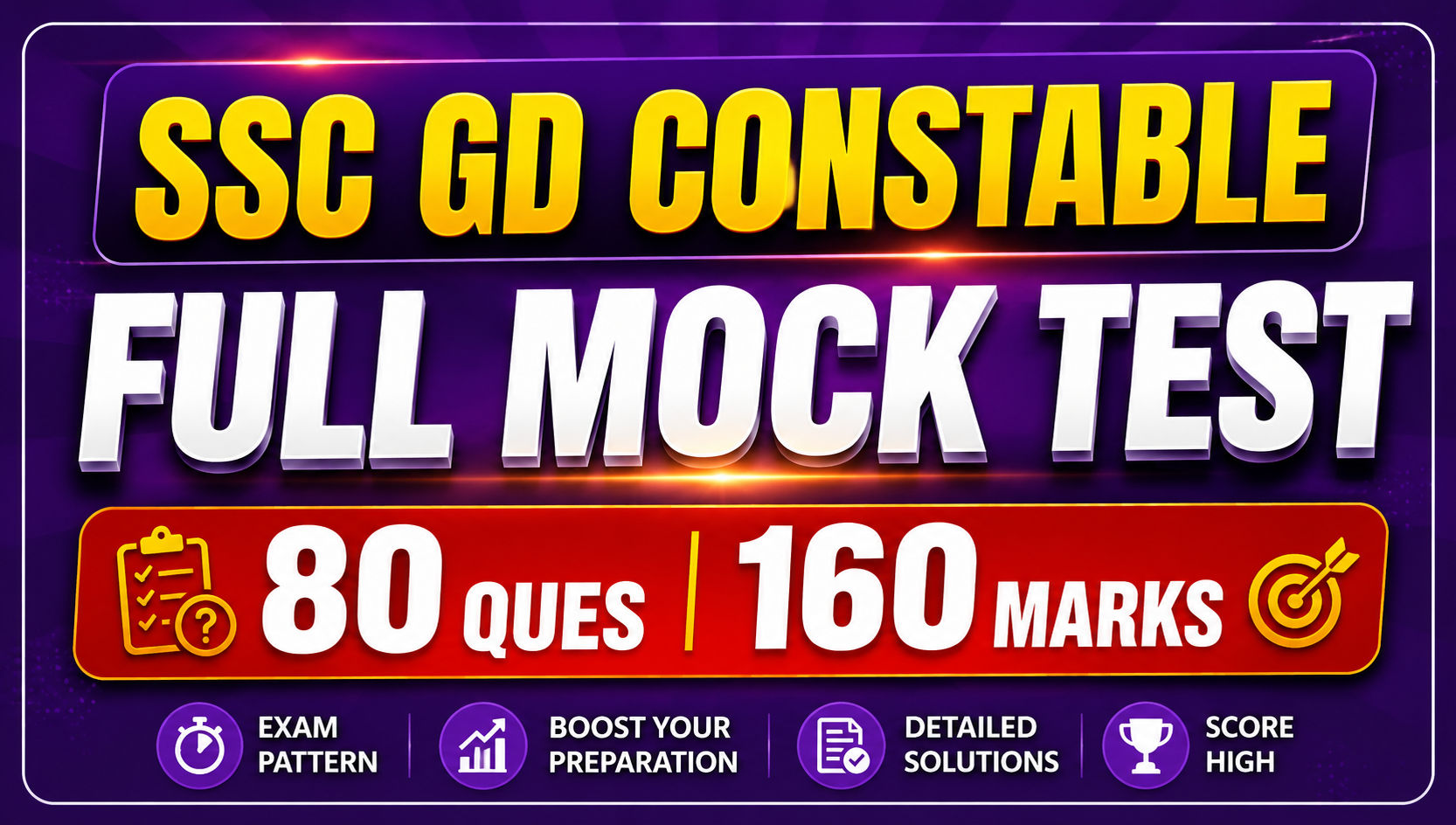
SSC GD FULL MOCK TEST [ HINDI ]
₹100₹20
SSC GD General Knowledge Mock Test Hindi
₹499₹49
SSC GD Polity + all VVI subject Mock Test 250 MCQ Hindi Medium
₹499₹9
SSC Exams General Knowledge Test

₹2
SSC GD Mock test ( Indian History )
₹50₹15
Indian States & Capitals Mock Test [250 MCQ (Hindi Medium)] for SSC GD, SSC CGL, SSC MTS, SSC GD, RRB, Police, UPPSC, Banking, CTET/TETNDA/CDS and other competitive exam v
₹99₹9
SSC GD General Hindi + other imp. subject Mock Test - 250 MCQ Hindi Medium

₹499₹49
SSC GD Rivers of India Mock Test 250 MCQs Hindi
₹499₹9
Census Mock Test 250 MCQ Hindi Medium for SSC GD, SSC CGL, SSC MTS, SSC GD, RRB, Police, UPPSC, Banking, CTET/TETNDA/CDS and other competitive exam
₹99₹9
An SSC GD mock test is the closest you can get to the real Computer Based Examination (CBE) before exam day. The paper itself is set at Class 10 level, but 80 questions in 60 minutes with negative marking is a test of speed, accuracy and decision-making as much as knowledge. That is exactly what regular mock practice trains.
Why SSC GD Mock Tests Matter
Real exam pressure: A timed mock shows whether you can actually finish 80 questions in 60 minutes, not just solve them at your own pace.
Accurate self-assessment: Your mock score tells you where you stand against previous cut-offs for your state and category.
Weak-area discovery: Section-wise results show which subject is pulling your total down.
Negative marking judgement: You learn when to attempt a doubtful question and when to leave it.
Interface comfort: Practising on a computer screen reduces surprises on exam day.
In the SSC GD recruitment, only about eight candidates per vacancy are called for the physical stage. With margins that tight, a few marks gained through better time management can decide whether you move ahead.
What a Good SSC GD Mock Test Should Include
Not every test labelled "SSC GD mock" matches the real exam.
Feature | What to Look For |
|---|---|
Pattern | 80 questions: 20 each from Reasoning, GK, Elementary Maths and English/Hindi |
Marking | 2 marks per correct answer, 0.25 marks deducted per wrong answer |
Timing | 60 minutes for the full paper, with no sectional timer |
Difficulty | Matriculation level, close to recent SSC GD papers |
Language | English or Hindi, and ideally your regional language if you plan to use it |
Solutions | Step-by-step explanations, not just the correct option |
Analysis | Section-wise score, accuracy and time spent per question |
Coverage | Current affairs updated for the months before your exam |
SSC also offers a free mock test of the CBE interface in the Candidate's Corner section of its website. Take it at least once to get used to the official screen layout.
Types of SSC GD Mock Tests
A strong practice plan uses different kinds of tests at different stages.
Test Type | When to Use It | Purpose |
|---|---|---|
Topic-wise tests | While learning a chapter | Check understanding of one syllabus topic, such as percentages or coding-decoding |
Sectional tests | After finishing a subject | Build speed and accuracy in one section |
Previous year paper mocks | Throughout preparation | Understand the real difficulty level and question style |
Full-length mock tests | Final two to three months | Practise the complete 60-minute paper under exam conditions |
How Many SSC GD Mock Tests Should You Take?
There is no magic number. Twenty well-analysed mocks help more than sixty rushed ones. A practical plan for the 2027 cycle looks like this:
Phase | Approx. Timeline | Mock Practice |
|---|---|---|
Foundation | October to November 2026 | Topic-wise tests after each chapter; one full mock every two weeks to track progress |
Practice | December 2026 | Sectional tests daily; one full mock a week |
Mock phase | January 2027 until the exam | Two to three full mocks a week, with a full day of analysis after each |
Final week | Before your exam date | One or two mocks at your actual exam time slot; focus on revision |
If your exam slot is in the morning, take your final mocks in the morning too. Your brain gets used to performing at that hour.
How to Take an SSC GD Mock Test the Right Way
Treat every full-length mock like the real exam:
Sit at a desk with no phone, notes or breaks for 60 minutes.
Use only rough paper; calculators are not allowed in the actual exam.
Follow a time plan, for example 8 to 10 minutes for GK, 10 to 12 minutes for the language section, 14 to 16 minutes for Reasoning and 16 to 18 minutes for Maths, with 5 minutes left for review.
Mark lengthy questions for review instead of getting stuck.
Submit only when the timer ends, even if you finish early.
How to Analyse an SSC GD Mock Test
The score is only the starting point. Real improvement comes from the analysis you do afterwards. Spend at least as long analysing a mock as you spent taking it.
Step 1: Sort Every Mistake
Classify each wrong or skipped question into one of these groups:
Mistake Type | Example | Fix |
|---|---|---|
Concept gap | You did not know the formula for compound interest | Revise the topic and solve 20 to 30 questions on it |
Silly error | You misread "not" in the question | Slow down on reading; underline key words mentally |
Calculation error | Wrong multiplication in a profit and loss question | Daily calculation practice without a calculator |
Time pressure | You skipped five Maths questions in the last minutes | Adjust your section order or time plan |
Guesswork gone wrong | You attempted a GK question with no idea of the answer | Attempt only when you can eliminate at least one option |
Step 2: Keep an Error Log
Maintain a notebook or spreadsheet with the topic, the mistake type and the correct method for each error. Revise it every week. After five or six mocks, patterns become obvious, and you know exactly which topics to fix first.
Step 3: Track Section-Wise Trends
Record your score in each section for every mock. If one section stays flat while others improve, that is where your next two weeks of study should go.
Step 4: Revisit Correct Guesses
Questions you got right by luck are hidden weaknesses. Mark them and study them like wrong answers.
What Score Should You Target in SSC GD Mock Tests?
Your target depends on your state and category, because SSC GD cut-offs are released separately for each. The difference between states is large. In 2024, the CBE cut-off for unreserved male candidates in the general area was about 140 in Uttar Pradesh and Rajasthan, but about 73 in Tamil Nadu.
A simple rule works well:
Find your state's latest cut-off for your category and gender in our SSC GD cut off guide or on ssc.gov.in.
Aim to score 10 to 15 marks above it consistently in full-length mocks.
For high-competition states such as Uttar Pradesh, Rajasthan, Haryana and Madhya Pradesh, that means working towards 145 to 150 out of 160.
Mock test scores can be slightly different from the real exam, so focus on steady improvement across several mocks rather than a single high score.
Common Mistakes Aspirants Make with Mock Tests
Taking mocks without analysis: Scores stay flat when mistakes are not studied.
Starting full mocks too late: Leaving all full-length practice to the last month does not give enough time to fix timing problems.
Chasing the number of mocks: Quality of analysis matters more than quantity.
Ignoring the language section: Many aspirants focus on Maths and Reasoning, yet vocabulary and grammar questions are among the quickest marks available.
Skipping physical training: Mock scores get you to the PET, but the 5 km run (1.6 km for women) decides whether you stay in the race.
SSC GD mock tests work best as a feedback system, not a score counter. Match your mocks to the official pattern, increase their frequency as the exam approaches, and spend real time on analysis. Set your target from your own state's cut-off, keep an error log, and use Testkart's SSC GD mock tests to measure your progress until the 2027 CBE.