
Homi Bhabha Exam Class 6 Course 2026-27: How to Choose
What a good course should cover, course types and how to pick one before the 28 November 2026 written test.
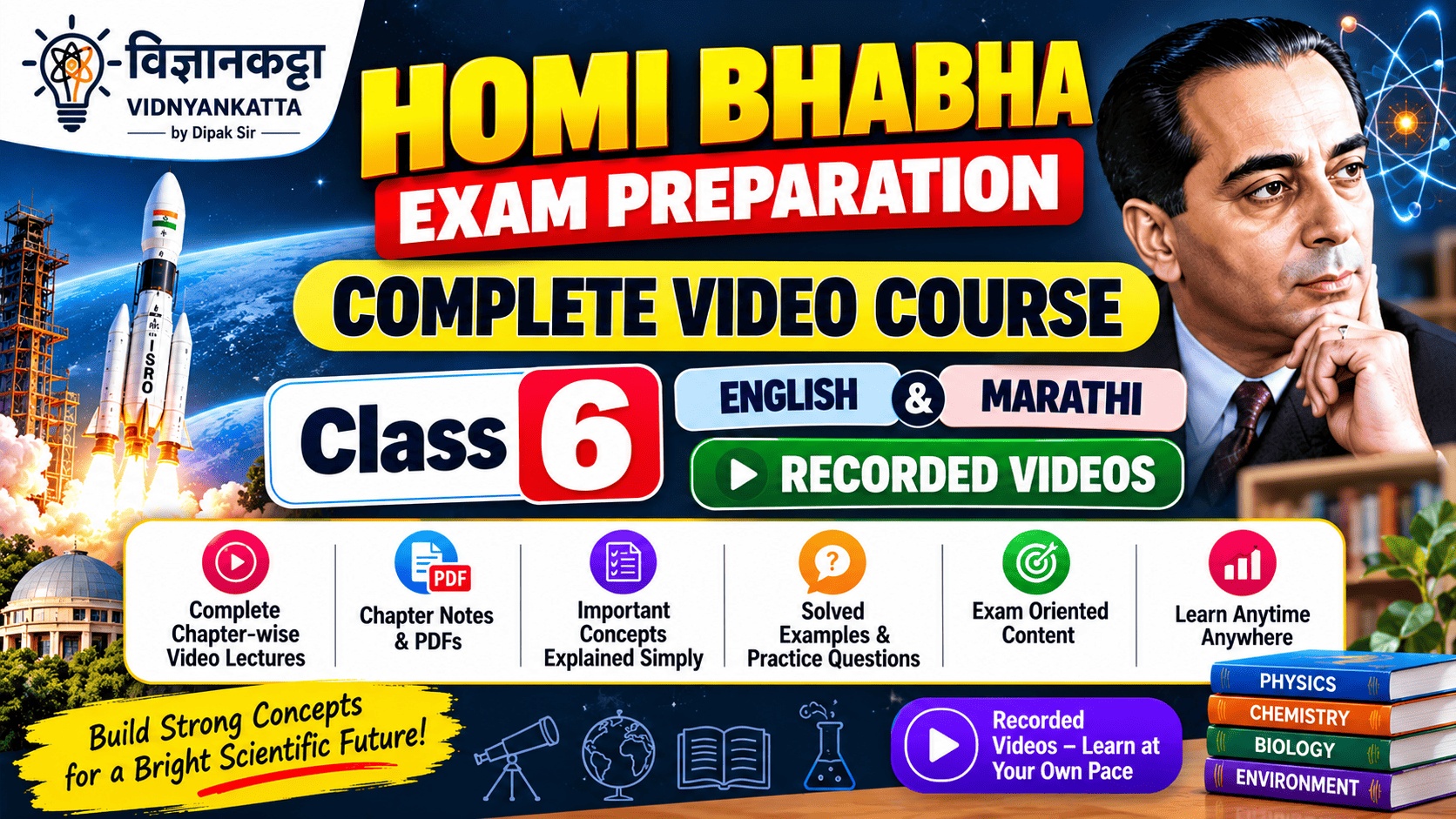
A Homi Bhabha exam Class 6 course gives a Std 6 student a planned route through three years of science, timed practice and the later practical and interview rounds. The Dr. Homi Bhabha Balvaidnyanik Competition is conducted by the Greater Bombay Science Teachers' Association (GBSTA), and the 2026-27 Level I written test is on 28 November 2026.
Many students prepare well with textbooks and a test series alone. A course helps most when a student needs a fixed schedule or teacher support for reasoning questions and the later rounds. This page explains what a good course should include and how to choose one.
What a Good Homi Bhabha Class 6 Course Should Cover
Std 6 science in depth: About 60% of the written paper comes from Std 6, so it should take most of the teaching time.
Std 4 and Std 5 revision: Together they carry about 30% of the paper and need regular, short revision.
Both Std 6 textbook editions: Maharashtra introduced a new Std 6 textbook in 2026-27, and GBSTA has not said which edition the paper follows. A good course teaches by topic and covers both.
Timed full-length tests: Practice papers should follow the real format of 100 MCQs in 90 minutes, with analysis of speed and accuracy.
Practical and interview support: The practical (10 January 2027) and the two interviews (14 March 2027) carry 90 of the 120 final marks.
Types of Homi Bhabha Class 6 Course
Type | Suits | Typical inclusions |
|---|---|---|
Written test course | Students starting preparation early | Std 4 to 6 concept lessons, chapter tests, general science sessions |
Full four-stage course | Students aiming for a medal | Written test lessons, practical demonstrations, interview practice, project guidance |
Revision or crash course | Students with a few weeks left before the written test | High-weight topics, previous year questions, full-length mocks |
Test series only | Self-driven students with a strong textbook base | Chapter-wise and full-length tests with performance analysis |
How to Choose the Right Course
Match the weightage: Check that the course plan follows GBSTA's split of roughly 60% Std 6, 20% Std 5, 10% Std 4 and 10% general knowledge in science.
Check the medium: The exam runs in English and Marathi, and the medium chosen at registration applies to all four stages. Pick a course in the same medium.
Look at the timeline: With the written test on 28 November, a course starting now should move quickly to timed practice rather than long theory modules.
Ask about later stages: Find out whether the course covers practical skills and the action research project.
Common Mistakes to Avoid
The most common mistake is choosing a course that stops at the written test. Others are skipping Std 4 and Std 5, which decide about 30 marks, and taking many lessons but too few timed tests.
For more information visit the official Homi Bhabha exams page on msta.in.
Teachers and coaching institutes preparing students for the competition can also create and offer their own courses and tests on Testkart.