
Rajasthan Subordinate and Ministerial Services Selection Board
RSMSSB is a recruitment exam conducted by Rajasthan Subordinate and Ministerial Services Selection Board, relevant to candidates preparing for state government department recruitment.
RSMSSB Study Material
Mock Tests
View allRajasthan CET Senior Secondary Level Free Mock Test 2026 - Full-Length Paper on Latest Pattern
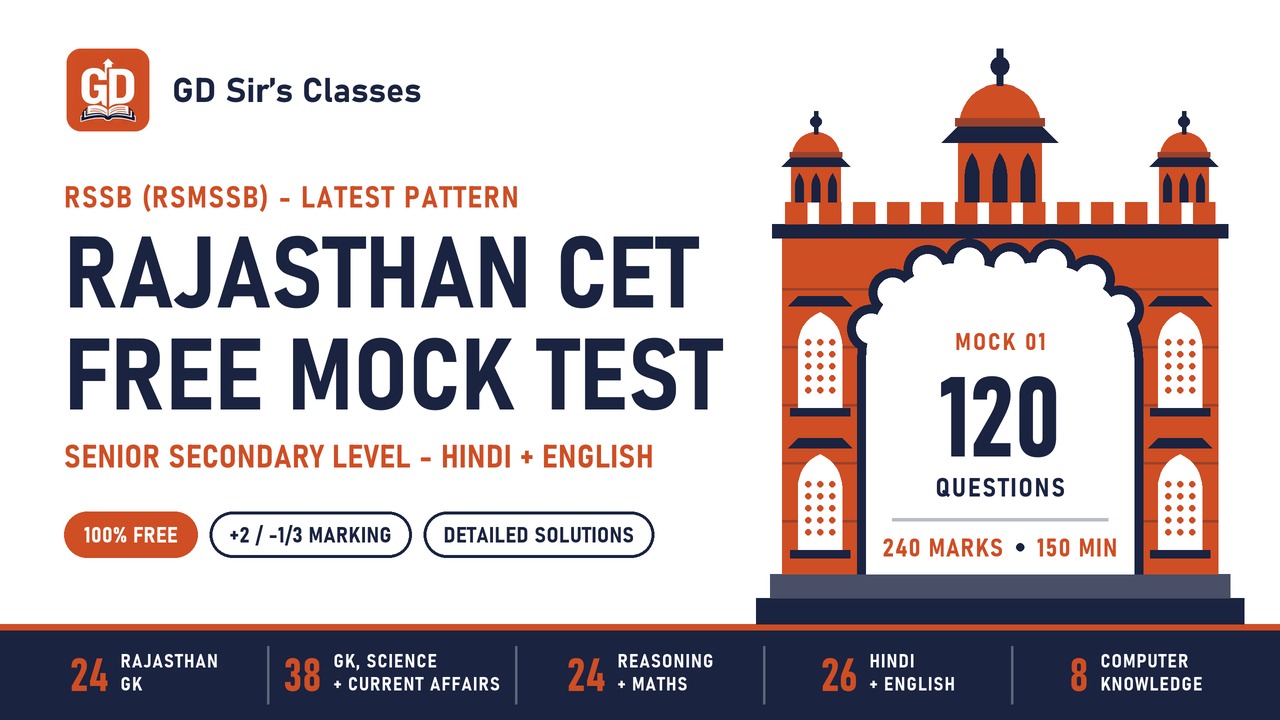
Free
Rajasthan History Test Series for REET, RPSC & CET,
₹100₹50
Rajasthan CET Graduation Level Free Mock Test 2026 - Full-Length Paper on Latest Pattern
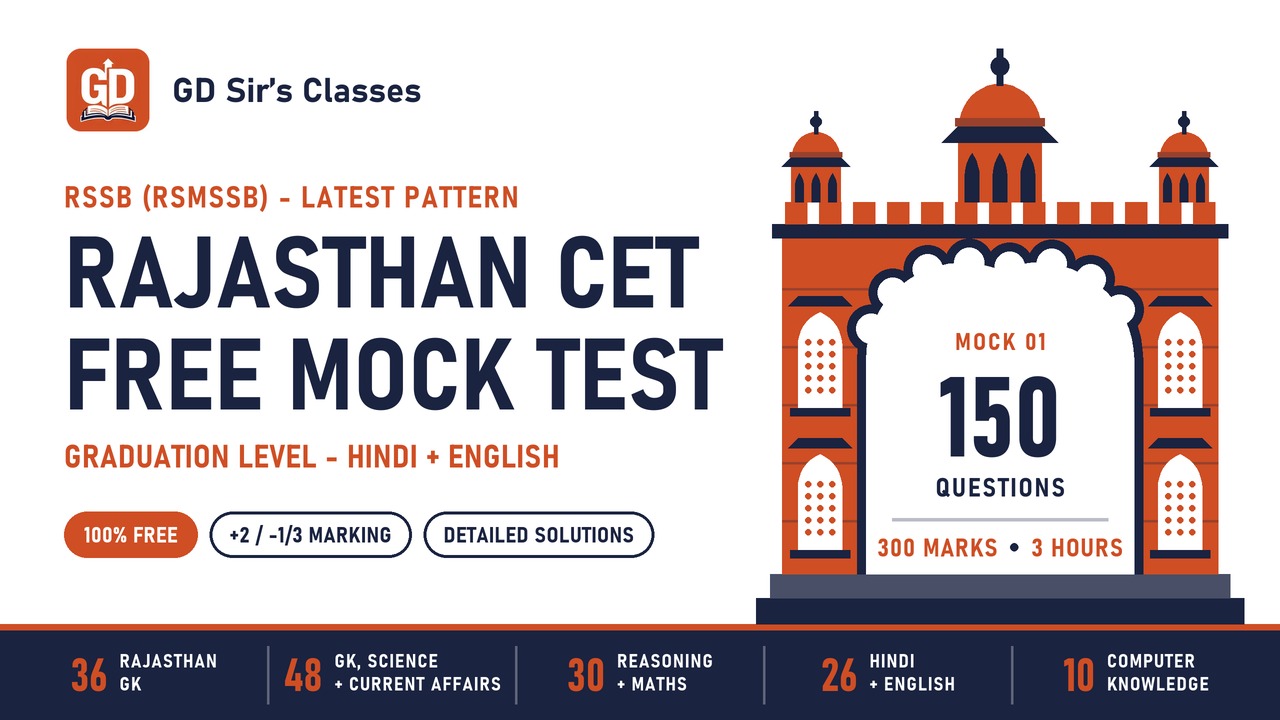
Free
Rajasthan CET Graduation Level Mock Test Series 2026 - 2 Full-Length Mocks
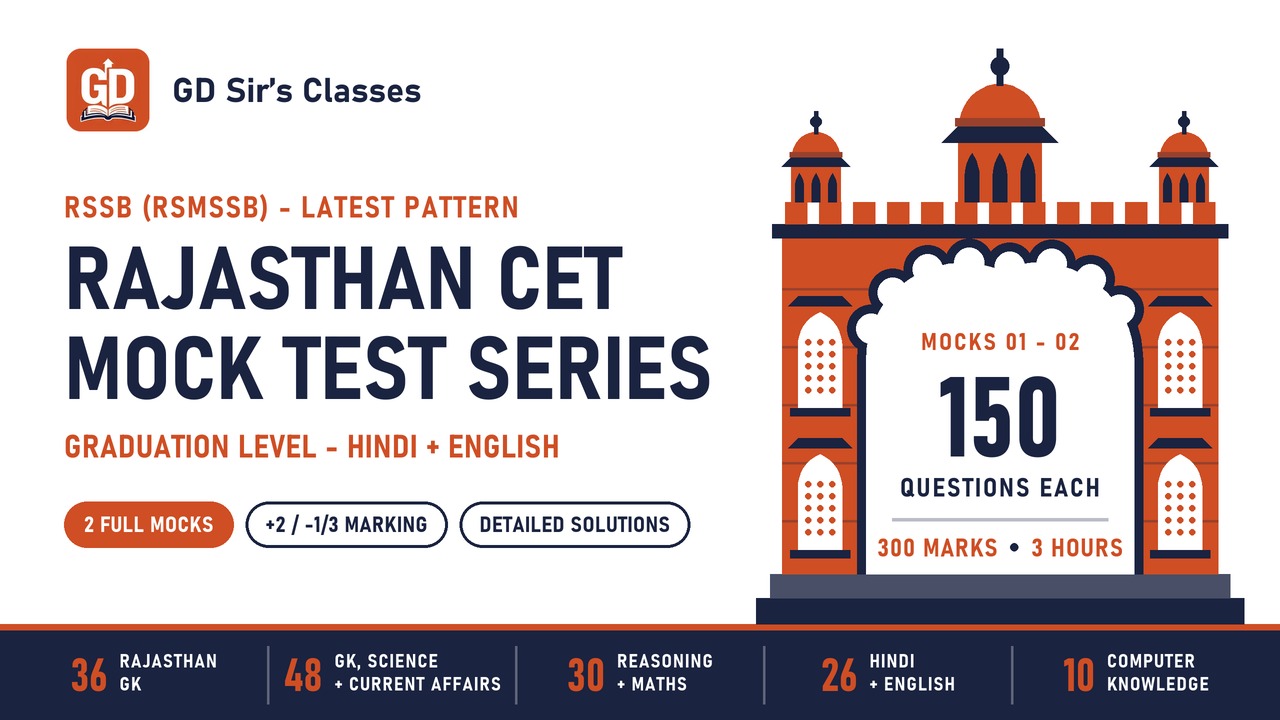
₹99₹19
The Rajasthan Subordinate and Ministerial Services Selection Board (RSMSSB), now officially called the Rajasthan Staff Selection Board (RSSB), recruits candidates for Group C and subordinate posts in Rajasthan government departments. Every year it runs the RSMSSB exam cycle for posts such as Patwari, Village Development Officer, Clerk Grade-II, Junior Assistant, Forest Guard, Supervisor, Lab Assistant and Junior Engineer, along with the Common Eligibility Test (CET) that most of these posts now require.
This page explains how RSMSSB recruitment works today: the CET-first system, the revised exam calendar for 2026-27, eligibility and age relaxation, fee, exam pattern, syllabus, salary, admit card, result and preparation. The biggest changes this cycle are the revised CET dates announced on 28 September 2026, a shorter Senior Secondary CET paper, and a CET score that now stays valid for three years.
Table of Contents
RSMSSB Exam at a Glance
RSMSSB or RSSB: Is It the Same Board?
How RSMSSB Recruitment Works: CET and Main Exam
RSMSSB Exam Calendar 2026-27
Recent RSMSSB Vacancies and Recruitments
RSMSSB Eligibility Criteria
RSMSSB Application Fee and How to Apply
RSMSSB Exam Pattern
RSMSSB Syllabus Overview
Popular RSMSSB Posts and Job Profile
RSMSSB Salary
RSMSSB Cut-Off and Qualifying Marks
RSMSSB Admit Card and Result
How to Prepare for RSMSSB Exams
RSMSSB Exam at a Glance
Particular | Details |
|---|---|
Board name | Rajasthan Staff Selection Board (RSSB), earlier Rajasthan Subordinate and Ministerial Services Selection Board (RSMSSB) |
Headquarters | Jaipur, Rajasthan |
Type of posts | Group C, subordinate and ministerial posts in state departments, plus some contractual posts |
Eligibility test | Common Eligibility Test (CET) at Graduate Level and Senior Secondary (12th) Level |
CET Graduate Level 2026 | 16 to 18 January 2027 (tentative) |
CET Senior Secondary Level 2026 | 1 to 3 December 2026 (tentative) |
Common age limit | 18 to 40 years for most posts (as on 1 January 2027 for the 2026 CET and several 2026 posts), with category relaxation |
Exam mode | Offline, OMR-based objective papers for most exams |
Negative marking | One-third of the marks of a question for each wrong answer in CET and most written exams |
Application route | Online through the Recruitment Portal on SSO Rajasthan |
Official website |
RSMSSB or RSSB: Is It the Same Board?
Yes. RSMSSB and RSSB are the same recruiting body. The board now uses the name Rajasthan Staff Selection Board in its notices, and its official website has moved to rssb.rajasthan.gov.in. Students, coaching institutes and search engines still use "RSMSSB" widely, which is why both names appear on result PDFs, books and test series.
The practical point is simple. Download notifications, admit cards and results only from the RSSB website, and apply only through the SSO Rajasthan Recruitment Portal. Older pages may still point to the old domain or to outdated fees and patterns, so always cross-check with the latest advertisement.
How RSMSSB Recruitment Works: CET and Main Exam
Most RSMSSB posts are now filled in two steps. First you qualify the CET for your education level. Then you apply separately for each post when its advertisement comes out, and the board shortlists candidates for the main exam on the basis of their CET score.
Qualify the CET: Take the Graduate Level CET for graduate posts or the Senior Secondary Level CET for 12th-level posts. You need at least 40% marks (35% for SC and ST candidates) to qualify.
Apply for the post: When a post-wise advertisement is released, apply with your valid CET score through the Recruitment Portal.
Shortlisting: The board calls a fixed multiple of the vacancies, in order of CET score, to the main exam. The exact ratio is given in each advertisement.
Main exam and further stages: The main written exam is followed, where the post requires it, by a typing test, skill test, physical test or interview.
Document verification and final merit: Final selection follows the recruitment rules of that post.
Some posts, such as Junior Engineer, Lab Attendant and Teaching Associate, are recruited without CET (the board labels them non-CET exams). For these you apply directly and sit one recruitment exam.
CET score validity: The CET score is now valid for three years from the date of result. The Senior Secondary CET 2024 score was valid for one year and expired on 16 February 2026, so candidates from that batch had to apply again for CET 2026. There is no limit on the number of CET attempts, and you can reappear to improve your score.
RSMSSB Exam Calendar 2026-27
The board released a revised calendar on 28 September 2026. It lists five exams between November 2026 and February 2027, and moved both CET levels away from October because of local body and Panchayati Raj elections in the state.
Exam | Type | Tentative date |
|---|---|---|
Teaching Associate (Contractual) Direct Recruitment 2026, 32 subjects | Non-CET | 17 November to 21 December 2026 (on selected days) |
Laboratory Attendant Direct Recruitment 2025 | Non-CET | 25 November 2026 |
Common Eligibility Test (Senior Secondary Level) 2026 | CET | 1 to 3 December 2026, two shifts a day |
Common Eligibility Test (Graduate Level) 2026 | CET | 16 to 18 January 2027 |
Junior Engineer Combined Direct Recruitment 2026 | Non-CET | 3 to 5 February 2027 |
These dates are tentative and the board has already revised its calendar more than once this year. Track the Latest News section on the RSSB website, and check your SSO inbox and registered mobile number before each exam.
Recent RSMSSB Vacancies and Recruitments
RSMSSB runs dozens of recruitments a year, from large clerical drives to small technical posts. The table below lists recent and ongoing ones that most aspirants follow. Figures are as reported in the respective advertisements and can be revised later.
Recruitment | Vacancies | Status (October 2026) |
|---|---|---|
Clerk Grade-II (LDC) and Junior Assistant 2026 (Advt. 04/2026) | 10,644 (9,642 Non-TSP, 1,002 TSP) | Written exam held on 5 July 2026; result declared on 28 September 2026; typing test next |
Junior Engineer Combined Recruitment 2026 | 874 (as reported) | Exam scheduled for 3 to 5 February 2027 |
Supervisor (Women) 2026 | 72 | Exam was rescheduled to 24 July 2026 in the May 2026 calendar revision; check the board for result updates |
Patwari 2025 | As per advertisement | Result declared; document verification in progress |
Village Development Officer 2025 | As per advertisement | Result and merit list declared |
CET Graduate Level and Senior Secondary Level 2026 | Eligibility test (no vacancies) | About 17 lakh and 24.5 lakh applicants reported; exams in December 2026 and January 2027 |
Posts that use the CET score, such as Patwari, VDO, Clerk Grade-II and Forest Guard, will be advertised after the CET 2026 results. Only candidates with a valid CET score can apply for them.
RSMSSB Eligibility Criteria
Eligibility depends on the post, but some rules apply across almost every RSMSSB recruitment.
Educational Qualification
CET Graduate Level: A bachelor's degree from a recognised university.
CET Senior Secondary Level: Class 12 (Senior Secondary) or equivalent from a recognised board.
Post-specific requirements: Many posts add a condition, such as computer certification (RS-CIT or equivalent) for clerical posts, a diploma or degree in engineering for Junior Engineer, or a relevant degree for technical and agriculture posts. Check the advertisement of each post.
Age Limit and Relaxation
The common age limit is 18 to 40 years. For CET 2026 and several 2026 recruitments, age is counted as on 1 January 2027. Relaxation applies to candidates who are original residents of Rajasthan in the reserved categories.
Category | Upper age relaxation |
|---|---|
SC, ST, OBC, MBC, EWS men (Rajasthan) | 5 years |
General category women | 5 years |
SC, ST, OBC, MBC, EWS women (Rajasthan) | 10 years |
PwBD | 10 years (General), 13 years (OBC/MBC), 15 years (SC/ST) |
Widows and divorced women | No upper age limit (subject to retirement age) |
Ex-servicemen | As per state rules stated in the advertisement |
Some advertisements add extra one-time relaxation when a post was not recruited for a year or more. The Supervisor (Women) 2026 recruitment, for example, gave every applicant one additional year.
Other Conditions
Nationality: Candidates must be Indian citizens.
Reservation: Category reservation and relaxation are only for original residents of Rajasthan. Reserved-category candidates from other states are treated as General.
Language: Most advertisements require working knowledge of Hindi written in Devanagari script and of Rajasthani culture.
RSMSSB Application Fee and How to Apply
RSMSSB charges a One Time Registration (OTR) fee rather than a fee for each post. Once paid, you can apply for later recruitments without paying again, subject to the board's rules.
Category | OTR fee |
|---|---|
General and creamy layer OBC/MBC | Rs. 600 |
Non-creamy layer OBC/MBC and EWS (Rajasthan) | Rs. 400 |
SC, ST and PwBD (Rajasthan) | Rs. 400 |
Steps to apply:
Log in to SSO Rajasthan with your SSO ID, or register if you are a new user.
Open the Recruitment Portal from the Citizen Apps (G2C) list.
Complete the One Time Registration with personal, category and education details.
Select the advertisement you want and click Apply Now.
Upload a recent photograph, signature and the documents asked for, then pay the fee online.
Submit the form and save the application number and a printout.
Most rejections come from mismatched names or dates of birth across documents, an expired category certificate, or a CET score that is not valid on the closing date. Check these before you submit.
RSMSSB Exam Pattern
Each post has its own scheme, but the two CET papers are common to most aspirants.
Exam | Questions | Marks | Time | Qualifying marks |
|---|---|---|---|---|
CET Graduate Level | 150 | 300 | 3 hours | 40% (35% for SC/ST) |
CET Senior Secondary Level | 120 | 240 | 2 hours 30 minutes | 40% (35% for SC/ST) |
Both CET papers are objective, OMR-based and carry 2 marks per question, with one-third of the marks deducted for each wrong answer. Main exams vary. The Clerk Grade-II and Junior Assistant 2026 exam, for instance, had two objective papers on the same day, each of three hours and 100 marks, followed by a typing test.
What this means for you:
A wrong answer costs two-thirds of a mark: Guess only when you can rule out at least two options.
Do not leave too many questions blank: Recent RSSB instructions require every question to be marked, including the option for not attempting it. Leaving more than 10% of questions without any bubble can lead to disqualification, so read your admit card instructions carefully.
The Senior Secondary paper is shorter: At 120 questions in 150 minutes, you get 75 seconds per question, the same pace as the Graduate paper.
Older pages may still show 150 questions and 3 hours for the Senior Secondary CET, so follow the 2026 notification. See the detailed RSMSSB exam pattern page for post-wise schemes.
RSMSSB Syllabus Overview
The CET syllabus is common to all candidates at a level. Main exams add post-specific subjects.
Subject area | Graduate Level CET | Senior Secondary CET |
|---|---|---|
History, art and culture | India and Rajasthan, with the national movement | Rajasthan history, art and culture |
Geography | India and Rajasthan | India and Rajasthan |
Polity and economy | Indian political system, economy of India and Rajasthan | Political system with Rajasthan focus, economy of Rajasthan |
Science | Science and technology | Everyday science |
Reasoning and maths | Yes | Yes |
Current affairs, civic duty and public health | Yes | Yes |
Computer, Hindi and English | Yes | Yes |
The board does not fix the number of questions per subject. Rajasthan GK (history, culture, geography, polity and economy of the state) is the single largest block, so it deserves the most revision time. For the full topic list, see the RSMSSB syllabus page.
Popular RSMSSB Posts and Job Profile
Post | Department (typical) | Main work |
|---|---|---|
Patwari | Revenue | Maintains village land records, mutations and revenue collection |
Village Development Officer | Rural Development and Panchayati Raj | Runs gram panchayat work, schemes and records |
Clerk Grade-II and Junior Assistant | Various departments and secretariat | Office files, data entry, correspondence and records |
Forest Guard and Forester | Forest | Patrolling, protection of forests and wildlife |
Supervisor (Women) | Women and Child Development | Supervises anganwadi centres and child-welfare schemes |
Junior Engineer | PWD, Water Resources, Panchayati Raj and others | Site supervision, estimates and project reports |
RSMSSB Salary
Pay is fixed under the Rajasthan pay matrix and differs by post. Clerk Grade-II and Junior Assistant posts are at Pay Matrix Level 5, while Supervisor (Women) is at Level 7. Technical posts such as Junior Engineer sit at higher levels.
New appointees serve a two-year probation, during which they receive a fixed monthly stipend instead of full pay. Full pay with allowances such as dearness allowance and house rent allowance starts after probation is confirmed. The exact stipend and pay level are printed in each advertisement, so check the post you are applying for.
RSMSSB Cut-Off and Qualifying Marks
Two different numbers matter. The CET qualifying mark is fixed at 40%, or 35% for SC and ST candidates. Clearing it only makes you eligible. The real competition is the post-wise cut-off for main-exam shortlisting and final merit, which the board publishes category-wise with each result.
Cut-offs change every year with difficulty, vacancies and the number of applicants. Treat last year's figures as a benchmark only, and aim for a clear margin above them rather than a bare pass. With over 24 lakh applicants for the Senior Secondary CET 2026 alone, a high CET score matters because shortlisting for main exams is done in order of score.
RSMSSB Admit Card and Result
Admit cards are released on the RSSB website a few days before each exam, often after an exam city intimation slip. To download one:
Visit rssb.rajasthan.gov.in and open the Admit Card section.
Select the exam you applied for.
Enter your application number and date of birth, or log in through SSO.
Download, print and check your name, photograph, centre and instructions.
Results, cut-off marks and merit lists appear in the Result section of the same website as PDFs. The board also publishes provisional answer keys with an objection window before the final result.
How to Prepare for RSMSSB Exams
Build Rajasthan GK first: History, art and culture, geography and polity of Rajasthan appear in every CET and most main exams. Make one set of short notes and revise it every week.
Practise reasoning and maths daily: Twenty to thirty mixed questions a day keep speed steady. Focus on percentage, ratio, profit and loss, time and work, series and coding-decoding.
Do not ignore Hindi and English: Grammar-based questions are predictable and score well with regular practice.
Add the new topics: Public health (first aid, CPR, drug abuse, social media addiction) and the Rajasthan Public Examination (Unfair Means) Act, 2022 are now part of the CET syllabus.
Read current affairs with a Rajasthan lens: Track state schemes, budget announcements and appointments along with national news.
Solve previous papers and take timed mocks: Because of negative marking, accuracy matters as much as attempts.
Before the CET, take at least eight to ten full-length mocks in OMR conditions, analyse each one the same day, and keep an error log of facts and question types you got wrong. If you are aiming at a specific post, move to its main exam syllabus as soon as the CET is over, since main exams usually follow within a few months.