
UP TGT Mock Test 2026: Online Practice Tests
Practise UP TGT mock tests in the revised 120-question pattern, with timed tests and section-wise analysis.

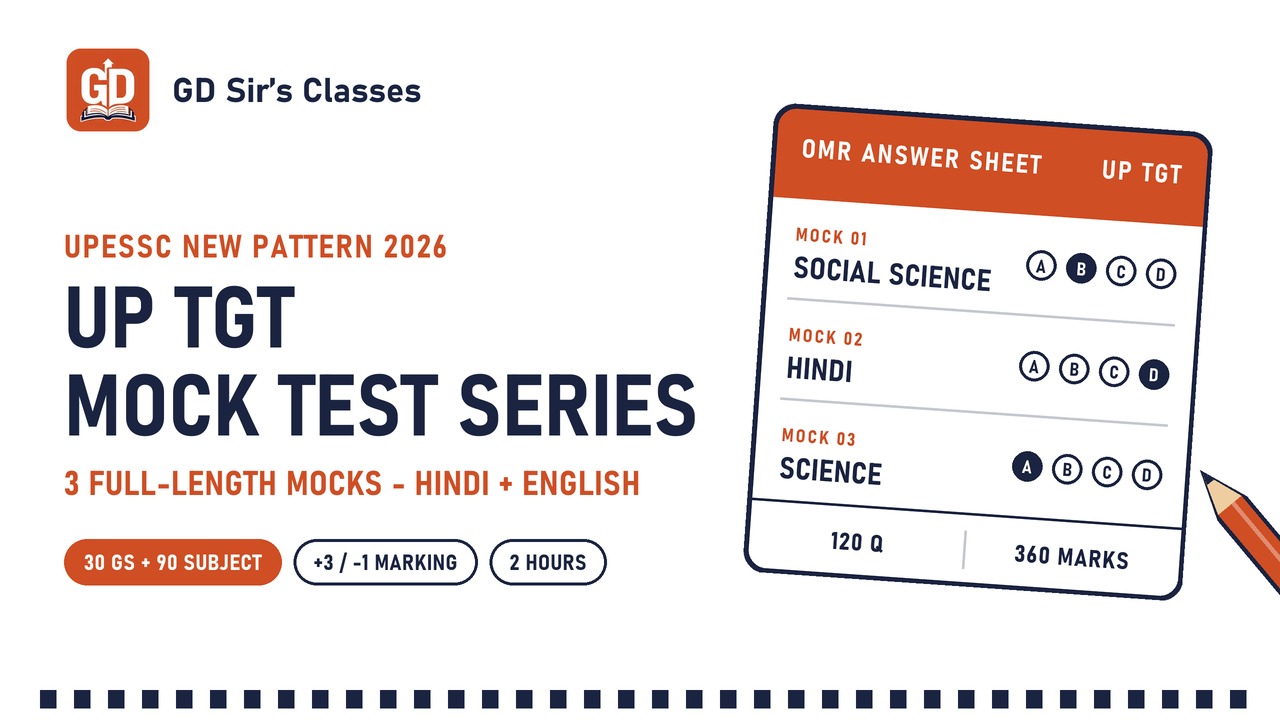
UP TGT mock tests help you practise the one paper that decides your selection. With the revised pattern of 120 questions, 360 marks and negative marking, timed practice now matters as much as subject knowledge. A good mock shows you where you lose marks: slow calculations, weak General Studies, or careless guesses.
UPESSC does not publish official mock tests or practice tests for UP TGT. The commission's website carries notices, syllabus PDFs, answer keys and results, so use it to check the current pattern and syllabus before you practise.
Table of Contents
Types of UP TGT Mock Tests
Test type | What it covers | When to take it |
|---|---|---|
Topic-wise test | One unit of your subject, such as Hindi poetics or Algebra | Right after finishing that unit |
General Studies test | 30 questions on current affairs, polity, history, geography and UP GK | Weekly, from the second month |
Full-length mock | 120 questions in 2 hours in the revised pattern | Last 6 to 8 weeks, two or three a week |
Previous year paper | Actual past TGT questions in your subject | Early, to judge depth, and again near the exam |
How to Use Mock Tests
Start with topic tests: Build accuracy unit by unit before you worry about time.
Add General Studies sets: Keep a weekly 30-question GS test so this section does not lag behind.
Move to full mocks: Sit each test in one two-hour block at the same time of day as the real exam.
Review on the same day: Analysis is where the marks are gained, so never skip it.
The UP TGT tests listed on this page give you timed practice, and the section-wise analysis on Testkart helps you see where your marks went in each attempt. Use it to decide what to revise before your next test.
How to Analyse a Mock Test
Wrong answers: Note the concept behind each one in an error log and revise it within a week.
Guesses: Count how many wrong answers were guesses. Under negative marking, these cost you a mark each.
Slow questions: Mark any question that took more than two minutes and practise similar ones.
Skipped but solvable: Find questions you left blank but could have answered. These are your easiest gains.
Common Mistakes
Practising the old pattern: Tests with 125 questions and no penalty do not match the revised paper.
Taking mocks without analysis: A score alone does not tell you what to fix.
Starting full mocks too late: Leave enough weeks to act on what the tests show.
Ignoring the error log: Repeating the same mistakes across tests is the clearest sign that analysis is not being used.
For official notices, syllabus PDFs and answer keys, visit the UPESSC official website.