
Union Public Service Commission Civil Services Examination
The premier examination for recruitment to top civil services of India like IAS, IPS, IFS, and IRS.
UPSC CSE Study Material
Mock Tests
View allUPSC Prelims Mega Mock Test 750 MCQs Hindi
₹999₹99
UPSC Prelims Ancient History Test

₹29
UPSC CSE Prelims 2026

₹100
UPSC CSE Prelims 2027 Mock Test

₹10
UPSC Prelims Ancient History Mock Test 1

₹29
Current Affair Mock Tests 2025-26

₹149
Study Notes
View allUPSC Prelims Polity One-Page Revision Notes
1 pagesFree
Laxmikanth 8th Edition Summary Notes
376 pages₹100
UPSC GS Paper 1 Indian Society Complete Notes
48 pages · 3 files₹200
Himalayan River System with Pictures & Hacks
12 pages₹9
UPSC Modern History Spectrum Revision Bundle PDF
237 pages · 3 files₹199
Advent of Europeans in India - Quick Revision Notes for UPSC CSE & UGC-NET
17 pagesFree
Bundles
View allUPSC CSE HISTORY NOTES
7 itemsSave 36%₹203₹129
Indian History GK Presentation PDF Bundle | Ancient, Medieval and Modern

3 itemsSave 14%₹63₹54
All Competitive Exams VVI MCQ Question Bank in hindi medium
56 itemsSave 84%₹32,045₹4,999
UPSC All Exams Complete Test Series Bundle PDF
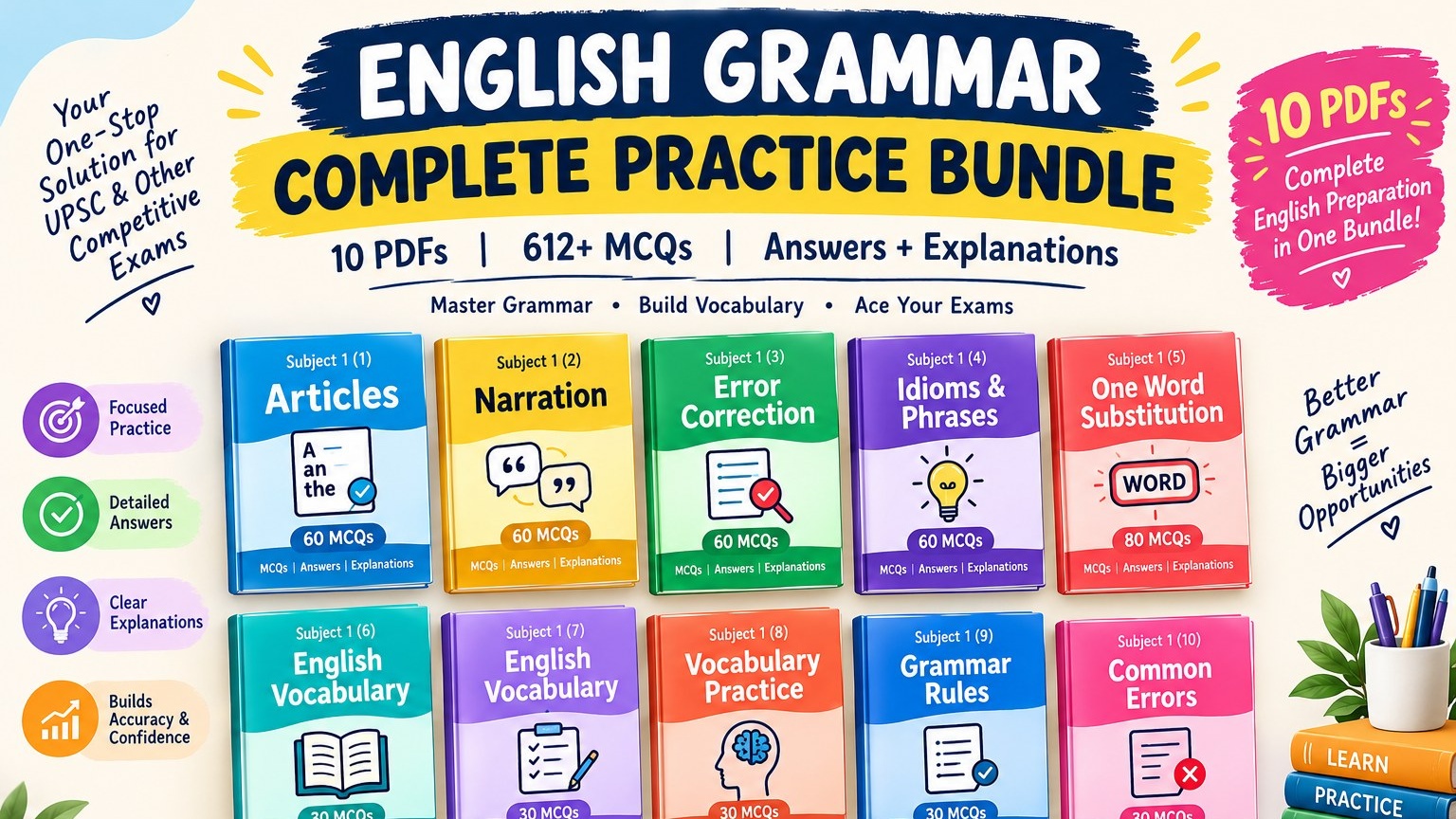
12 itemsSave 53%₹631₹299
COMPLETE Ancient Indian History Master Notes Bundle | UPSC & UGC NET

12 itemsSave 45%₹183₹100
The UPSC CSE 2027 is the Civil Services Examination conducted by the Union Public Service Commission to recruit officers for the IAS, IFS, IPS and other central services. It has three stages: the Preliminary Examination, the Main Examination and the Personality Test. The next cycle follows the Commission's annual calendar, which schedules the notification for 13 January 2027.
This page puts the essentials in one place: dates, vacancies, eligibility, fee, application steps, exam pattern, syllabus outline, selection process, pay and a preparation plan. Rules and figures are taken from Examination Notice No. 05/2026-CSE, the latest official notice, and the 2027 calendar on upsc.gov.in. The 2027 notice may change some of them, so confirm against it once it is out.
UPSC CSE 2027
Particular | Details |
|---|---|
Exam name | Civil Services Examination (CSE) 2027 |
Conducting body | Union Public Service Commission (UPSC) |
Services covered | 23 services and posts in the 2026 notice (18 Group A, 5 Group B) |
Vacancies | About 933 in the 2026 cycle; 2027 figure awaited |
Stages | Prelims (objective), Mains (written), Personality Test |
Qualification | Graduate degree in any discipline |
Age limit | 21 to 32 years in the 2026 notice, with category relaxations |
Attempts | 6 general, 9 OBC, unlimited for SC and ST (within the age limit) |
Prelims | 23 May 2027 (Sunday) |
Mains | From 20 August 2027, over five days |
Apply at | upsconline.nic.in |
Notification and Cycle Status
The 2026 notification was released on 4 February 2026 with 24 February 2026 as the notified last date. It announced about 933 vacancies, fixed the Prelims for 24 May 2026, and the Mains were held from 21 to 30 August 2026. For 2027, the calendar released on 20 May 2026 schedules the notification for 13 January 2027.
These points from the 2026 notice are worth knowing before you plan:
Face authentication: Every candidate goes through face authentication at the venue. Reach at least 30 minutes before each session, because late entry is not allowed.
Serving officers: A candidate already appointed to the IAS or IFS through an earlier exam, and still in that service, cannot appear. Separate one-time rules apply to those allocated the IPS or a Group A service.
Question paper representations: Appeared candidates can challenge Prelims questions and the answer key on the portal. The window runs from the third day after the exam to 6:00 pm on the seventh day.
No Prelims marksheet: The Prelims is only a screening test, so marks sheets are not issued to candidates.
UPSC CSE 2027 Important Dates
Event | Date |
|---|---|
Notification | 13 January 2027 (scheduled) |
Last date to apply | 2 February 2027 (scheduled) |
Preliminary Examination | 23 May 2027 (Sunday), one day |
Main Examination | From 20 August 2027 (Friday), five days |
Personality Test and final result | To be announced |
Indian Forest Service Main | 21 November 2027 (separate exam) |
These dates come from the Commission's annual calendar and are liable to alteration. Track the official notice on upsc.gov.in and your registered email. The Indian Forest Service uses the same Prelims but has its own Mains.
Vacancies and Services
The 2026 notice listed about 933 vacancies, including 33 for Persons with Benchmark Disability: 7 for blindness and low vision, 11 for deaf and hard of hearing, 8 for locomotor disability and 7 for multiple disabilities. The final number can change once cadre-controlling authorities confirm firm vacancies. Treat it as indicative for 2027.
Group | Services |
|---|---|
All India Services | Indian Administrative Service, Indian Foreign Service, Indian Police Service |
Central Services, Group A | Audit and Accounts, Civil Accounts, Corporate Law, Defence Accounts, Defence Estates, Information, Postal, P&T Accounts and Finance, Railway Management (Traffic, Personnel, Accounts), Railway Protection Force, Revenue (Customs and Indirect Taxes), Revenue (Income Tax), Trade Service |
Group B | Armed Forces Headquarters Civil Service, DANICS, DANIPS, PONDICS, PONDIPS |
UPSC CSE Eligibility Criteria
Nationality and Qualification
For the IAS, IFS and IPS, you must be a citizen of India. For the other services, subjects of Nepal or Bhutan and certain persons of Indian origin can also apply, but they need a certificate of eligibility from the Government of India. The minimum qualification is a graduate degree from a recognised university. Final-year students can apply, provided they submit proof of passing when they qualify for the interview. MBBS candidates who have not finished their internship are admitted provisionally.
Age Limit and Relaxation
The 2026 notice required candidates to be at least 21 and below 32 years on 1 August 2026, which meant birth dates from 2 August 1994 to 1 August 2005. The 2027 notice will set a fresh reference date. The upper limit is relaxed as follows.
Category | Upper age relaxation |
|---|---|
SC and ST | Up to 5 years |
OBC (eligible for reservation) | Up to 3 years |
Ex-servicemen, including ECOs and SSCOs with five years of service | Up to 5 years |
Defence personnel disabled in operations | Up to 3 years |
Persons with Benchmark Disability | Up to 10 years |
Number of Attempts
General and EWS candidates get six attempts, OBC candidates nine, and SC and ST candidates unlimited attempts within the age limit. Persons with Benchmark Disability get nine attempts in the general, EWS and OBC categories, and unlimited for SC and ST. Appearing in even one Prelims paper counts as an attempt.
Application Fee and How to Apply
Stage | Fee | Exempted |
|---|---|---|
Prelims | Rs. 100 | Women, SC, ST, PwBD |
Mains (additional) | Rs. 200 | Women, SC, ST, PwBD |
Pay by net banking, a Visa, Master or RuPay card, or UPI. The Mains fee is paid in the 10-day window opened after the Prelims result.
Register once: Create your account on upsconline.nic.in to get a Universal Registration Number, valid for all UPSC exams.
Complete the Common Application Form: Upload your photograph, capture a live photo and upload three signatures on plain white paper in black ink.
Fill the exam-specific module: Choose the centre, optional subject, medium, compulsory Indian language and service preferences.
Pay and submit: Note your application number. Applications cannot be withdrawn or corrected after submission.
Download the e-Admit Card: It is issued on the last working day of the week before the exam, and none is sent by post or email.
Optional subject, medium and Mains centre cannot be changed once the form is submitted, so decide them before you start.
UPSC CSE Exam Pattern
The Prelims only screens candidates. Your rank is decided by the Mains and the Personality Test.
Prelims Pattern
Paper | Questions | Marks | Duration | Nature |
|---|---|---|---|---|
General Studies Paper I | 100 (recent years) | 200 | 2 hours | Used for Mains shortlisting |
General Studies Paper II (CSAT) | 80 (recent years) | 200 | 2 hours | Qualifying, 33% minimum |
Both papers are objective with four options. Each wrong answer costs one-third of that question's marks, so 0.66 in Paper I and 0.83 in CSAT. Blank answers carry no penalty, and marking more than one option counts as wrong. The notice does not print question counts, so the numbers above follow recent papers. About 12 to 13 times the number of vacancies move on to the Mains.
Mains Pattern
Paper | Subject | Marks | Counted in merit |
|---|---|---|---|
Paper A | Compulsory Indian language | 300 | No, qualifying (25%) |
Paper B | English | 300 | No, qualifying (25%) |
Paper I | Essay | 250 | Yes |
Papers II to V | General Studies I to IV | 250 each | Yes |
Papers VI and VII | Optional subject, Papers 1 and 2 | 250 each | Yes |
Each paper lasts three hours, and the counted papers total 1,750 marks. You can choose from 25 optional subjects or the literature of any one of 23 languages. Papers can be written in English or any Eighth Schedule language, and the optional papers can be written in English even if the rest are not.
Personality Test
The interview carries 275 marks with no minimum qualifying score, and roughly twice the number of vacancies are called. The panel looks at mental alertness, balance of judgement, clarity of expression and integrity rather than testing subject knowledge. Mains and interview marks together make the 2,025-mark final merit.
What This Means for You
CSAT is a gate: It does not add to your rank, but you need 33 per cent, which is 66 marks out of 200. Do not leave it for the last month.
Guess with elimination: In Paper I a correct answer earns 2 marks and a wrong one costs 0.66. A blind guess roughly breaks even, while ruling out two options tips the odds in your favour.
Mains decides rank: It carries about 86 per cent of the final merit marks, so plan writing practice early.
Language papers can block you: The other Mains papers are evaluated only if you score 25 per cent in both qualifying papers.
Older pages may still show outdated marks totals or optional subject counts, so follow the official notice.
UPSC CSE Syllabus Summary
The official syllabus is printed in the notice, and the Commission also revises it from time to time.
Stage | Paper | Main areas |
|---|---|---|
Prelims | Paper I | Current events, Indian history and national movement, Indian and world geography, polity and governance, economic and social development, environment and climate change, general science |
Prelims | Paper II | Comprehension, communication skills, logical reasoning, decision making, general mental ability, basic numeracy and data interpretation (Class X level) |
Mains | Essay | Essays on multiple topics, judged on orderly and concise expression |
Mains | GS I | Indian heritage and culture, world history and geography, society |
Mains | GS II | Governance, constitution, polity, social justice, international relations |
Mains | GS III | Technology, economic development, biodiversity, environment, security, disaster management |
Mains | GS IV | Ethics, integrity and aptitude, with case studies |
Mains | Optional | Honours degree level; bachelor's level for engineering, medical science and law |
UPSC CSE Selection Process
Prelims: Qualification depends on your Paper I marks and the 33 per cent rule in Paper II. Marks do not count towards the final rank.
Mains: After the Prelims result you get a 10-day window to confirm your details in the detailed application form and pay the Mains fee.
Personality Test: Candidates who clear the Mains cutoff update their details in a 15-day window, then receive an e-summon letter.
Final merit and allocation: Ranks come from 2,025 marks, and services are allotted by rank and your preferences. Original documents are verified only after you qualify for the interview.
Salary and Career
New IAS, IPS and other officers enter at Pay Level 10 of the pay matrix, with a basic pay of Rs. 56,100 a month under the 7th Pay Commission. The pay scale rises to a basic of Rs. 2,50,000 for the Cabinet Secretary at Level 18. These are basic pay figures from the central pay matrix, not UPSC figures, and allowances come on top. They may change if a new pay commission is applied.
UPSC CSE Cut-off
The Commission releases Prelims marks and cut-offs only after the whole cycle ends. Cut-offs change every year with difficulty, vacancies and the number of applicants. Treat past figures as a benchmark only, and aim for a clear margin above them rather than a bare pass.
How to Prepare for UPSC CSE 2027
Weeks 1 to 8: Build the base in polity, geography, history, economy and environment, and read one newspaper daily.
From week 3: Give 30 to 40 minutes a day to current affairs and keep monthly notes.
From week 6: Start topic-wise tests and short CSAT sets.
From week 10: Practise timed answer writing for General Studies and the essay, and revise your UPSC study notes every week.
Final phase: Take full-length Prelims mocks, analyse them the same day and revise from an error log.
Pair mock tests with previous year papers to understand the real difficulty level. If you are choosing your optional subject, read its syllabus first and check that it overlaps with General Studies.