
The Central Board of Secondary Education (CBSE) Class 9
CBSE Class 9 Study Material

Mock Tests
View allMotion - Class 9 Mock Test

Free
Cell - Structure and Functions MCQ Test

₹29
colours of nature

Free
Class 9 Science Mini Practice Test | 25 MCQs
₹9
School Exams

₹29
Study Notes
View allClass 9 Science Presentation PDF - Reproduction: How Life Continues | Chapter 11
33 pages₹21
Class 9 Science Presentation PDF - Work, Energy and Simple Machines | Chapter 7
31 pages₹21
Class 9 Science Presentation PDF - Patterns in Life: Diversity and Classification | Chapter 12
34 pages₹21
Class 9 SST Presentation PDF - The Price Puzzle: What Drives the Market | Understanding Society India and Beyond Part-I Chapter 9
34 pages₹21
Class 9 SST Presentation PDF - Shaping of the Earth's Surface | Understanding Society India and Beyond Part-I Chapter 2
35 pages₹21
Class 9 Science Presentation PDF - Atomic Foundations of Matter | Chapter 9
31 pages₹21
Bundles
View allClass 9 English Kaveri Presentation PDF Bundle | Eight Chapters
8 itemsSave 26%₹104₹77
Class 9 Science Presentation PDF Bundle | Chapters 2–13
12 itemsSave 39%₹252₹154
Class 9 SST Presentation PDF Bundle | Understanding Society India and Beyond Part-I, Chapters 2–9
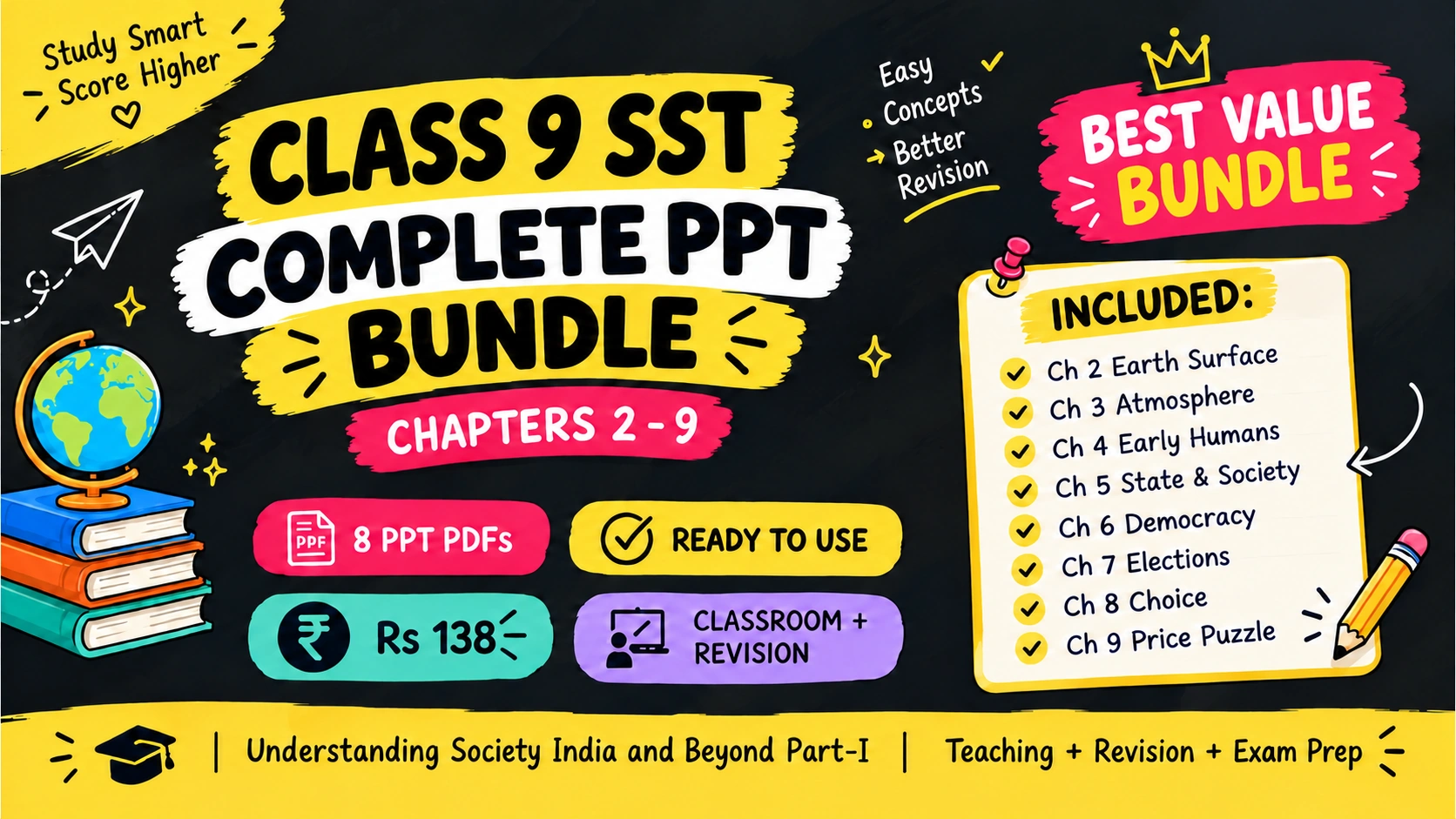
8 itemsSave 18%₹168₹138
CBSE Class 9 is the first year of the secondary stage in schools affiliated to the Central Board of Secondary Education. Unlike Class 10, it is not a board exam. Your school teaches the curriculum CBSE prescribes, sets and conducts the annual examination, and decides promotion to Class 10 using CBSE's assessment rules.
The 2026-27 session is a big change year. CBSE released the curriculum for Classes 9 to 12 through Circular Acad-14/2026 dated 1 April 2026, and Class 9 is the first class to follow the new scheme of studies based on the National Curriculum Framework for School Education 2023. This page explains what changed, the subjects, the exam pattern, passing rules, admission and registration, and how to prepare across the year.
CBSE Class 9 at a glance
Particular | Details |
|---|---|
Session | 2026-27 |
Curriculum set by | Central Board of Secondary Education (CBSE) |
Annual exam conducted by | Your own school (not a board exam) |
Who can join | Students who have passed Class 8 from a recognised school and meet the State or UT age norms |
Compulsory areas | Three languages (R1, R2, R3), Mathematics, Science, Social Science, Individuals in Society, Art Education, Physical Education and Well-being, plus Computational Thinking and AI modules and vocational education |
Optional extras | Mathematics at Advanced Level, Science at Advanced Level, and an optional subject |
Marks per main subject | 80 (annual exam) plus 20 (internal assessment) |
Passing rule | At least 33% separately in the annual exam and in internal assessment |
Registration | Schools register every Class 9 student with CBSE online; APAAR ID is mandatory |
Official curriculum | cbseacademic.nic.in (Curriculum 2026-27) |
What changed in the CBSE Class 9 curriculum for 2026-27
Older pages may still show the earlier Class 9 scheme with two languages and the old NCERT textbooks, so follow the 2026-27 curriculum documents. The main changes are:
Three languages are compulsory: Every Class 9 student studies R1, R2 and R3, and at least two of the three must be Indian languages, subject to transition relaxations for this batch.
R3 is assessed only by the school: There is no board exam for the third language. CBSE Circular Acad-49/2026 says a student who does not clear R3 in Class 9 is still promoted but must clear it in Class 10.
Two levels in Mathematics and Science: All students study the standard course. Students can also opt for the Advanced Level, which adds extra content and, at the Class 10 board stage, an additional 25-mark, one-hour paper of higher-order questions.
New NCERT textbooks: Ganita Manjari for Mathematics, Exploration for Science, Kaveri for English and a two-part Social Science book titled Understanding Society: India and Beyond.
New interdisciplinary area: Individuals in Society is introduced in Class 9 as a compulsory, school-assessed component.
Competency focus: Question papers place more weight on application and analysis, not just recall.
Subjects in CBSE Class 9
The scheme of studies groups subjects into compulsory and optional areas. CBSE also advises students to take only those subjects in Class 9 that they intend to continue in Class 10.
Area | Status | How it is assessed |
|---|---|---|
Language 1 (R1) and Language 2 (R2) | Compulsory | Annual exam (80) and internal assessment (20) |
Language 3 (R3) | Compulsory | School-based internal assessment only |
Mathematics (standard) | Compulsory | Annual exam (80) and internal assessment (20) |
Science (standard) | Compulsory | Annual exam (80) and internal assessment (20) |
Social Science | Compulsory | Annual exam and internal assessment (20) |
Mathematics or Science at Advanced Level | Optional | Additional 25-mark, one-hour paper in the Class 10 board exam; Class 9 assessment as decided by the school |
Individuals in Society, Art Education, Physical Education and Well-being | Compulsory | School-based assessment |
Optional subject (for example Computer Applications, Home Science, Painting, Artificial Intelligence, Information Technology) | Optional | As per the subject curriculum |
CBSE Class 9 exam pattern
Each main subject is marked out of 100. The school's annual examination carries 80 marks and lasts three hours, and internal assessment carries 20 marks.
Internal assessment (20 marks)
Periodic assessment: Pen-and-paper tests through the year. Three are held and the average of the best two counts.
Multiple assessment: Quizzes, oral work, presentations, projects and similar tasks.
Portfolio: Your classwork, reflections and best work collected over the year.
Subject enrichment: Practical work in Science, lab activities in Mathematics, and projects in languages and Social Science.
What this means for you
Internal marks are not a formality: You need 33% in internal assessment on its own, so submit every project and portfolio item on time.
Steady work beats a last-minute rush: Periodic tests count, and only your best two of three are averaged, so one bad day is recoverable.
Practise applying concepts: In Science, about half the theory marks test knowledge and understanding, while the rest test application and higher-order thinking.
Syllabus summary
Subject | Textbook | Highest-weight areas |
|---|---|---|
Mathematics | Ganita Manjari (NCERT) | Geometry (25 marks), Algebra (20), Mensuration (14) |
Science | Exploration (NCERT) | World of Living (27), Matter (25), Motion, Force, Work and Sound (23) |
English | Kaveri (NCERT) | Writing and Grammar (30), Literature (30), Reading (20) |
Social Science | Understanding Society: India and Beyond, Parts 1 and 2 (NCERT) | Theme-wise marks awaited from CBSE |
CBSE's Social Science curriculum for Class 9 says the course structure with marks will be provided shortly. Until it is issued, follow the theme list and your school's term plan.
Passing and promotion to Class 10
There is no rank or cut-off in Class 9. You are not competing with other students for seats. To pass a subject, you need at least 33% separately in the annual exam and in internal assessment, and you must complete both components. Results are reported with absolute grades from A1 (91 to 100) to D (33 to 40). Read the CBSE Class 9 passing marks and promotion rules for details.
Admission and registration
To join Class 9 in a CBSE school, a student must have passed Class 8 from an affiliated or recognised school, meet the age limits of the State or UT where the school is located, and produce a transfer certificate if moving from another school.
Important dates for 2026-27
Event | Date |
|---|---|
Curriculum 2026-27 released (Classes 9 and 10) | 2 April 2026 |
Three-language implementation guidelines (Circular Acad-49/2026) | 10 July 2026 |
Last date for Class 9 admission without CBSE permission | 31 August 2026 |
Class 9 registration with CBSE | Expected around September to October 2026 (tentative, based on the 2025-26 cycle) |
Annual examination | Set by each school, usually near the end of the session |
Tentative dates come from the previous cycle and can change. Track circulars on cbse.gov.in and your school's notices.
How to prepare for CBSE Class 9
Start from the NCERT textbook: School papers follow the new NCERT books closely. Read each chapter fully, including activities and in-text questions.
Build Mathematics daily: Algebra and Geometry carry 45 of 80 marks. Short daily practice works better than long weekend sessions.
Keep Science practical: Do the listed experiments carefully and record observations, because practical work feeds internal assessment.
Write in languages every week: Letters, articles, notices and essays improve only with practice and feedback.
Revise with short notes: Keep formula sheets, diagram lists and an error log for each subject.
Test yourself in exam format: Before periodic tests and the annual exam, attempt timed papers and review mistakes the same day.
Is Class 9 a foundation for the Class 10 board exam?
Yes. Students who enter Class 9 in 2026-27 will take the Class 10 board examination in 2028 under the same new scheme. Concepts in Class 9 Mathematics and Science, such as polynomials, coordinate geometry, atomic structure and motion, are built on in Class 10. A strong Class 9 year reduces the load in the board year.
The official curriculum documents are on the CBSE Academic curriculum 2026-27 page.